The project.
The software architecture, data model and hardware design are locked. What's next is the physical MVP — and the field, where ideas either break or prove themselves.
Two failures no one solved.
Heat-detection technology has been around for years. It just wasn't designed for this animal, this place, or this budget.
The Buffalo's Blind Spot
Buffalo heat is mostly silent, happens at night, and often with the animal submerged in ponds or mud — exactly where conventional sensors, built for stabled dairy cows, suffer total signal attenuation.
- Silent
- Nocturnal
- Submerged
The Economic Barrier
Fitting every female with an active collar costs €100+ per animal. On an average farm, the upfront investment becomes prohibitive — so heat detection is still done by eye, with the cost piling up every day.
- €100+ / collar
- €4 / open day
The model fits in one line.
There's no magic in the savings: idle days simply stop existing. The rest is arithmetic — and it's open to scrutiny.
Annual Savings = N × ΔD × C_diário- N
- Herd size100 females
- ΔD
- Average reduction in open days15 days
- C_diário
- Cost of an empty animal, per day€4 / day
Standard farm in Viseu · 100 head
What's locked in, and what's left.
The software and architecture are settled. What's left is steel, resin and fieldwork — and that's what the 2027 pilot will pay for.
Hybrid network architecture (BLE + LoRaWAN)
DoneAsymmetric topology designed and validated: one active node on the male, passive tags on the females, free-band transmission.
Mount-detection algorithm
DoneFirmware logic structured: on-board sensor detection, proximity validation and the store-and-forward protocol.
Dashboard prototype
DoneProducer interface prototyped in a simulated environment, with heat alerts and network mapping.
First batch of PCBs manufactured
PlannedProduction of the first boards and lab watertightness testing — the enclosure has to withstand full immersion (IP68).
Real-world pilots
PlannedCattle herd in Viseu and buffalo herd in Ribatejo — the only place where the algorithm proves itself.
Here's what it will look like in the field.
AI-generated illustrative concepts to visualize the device in use — not photos from a real pilot, which only starts in 2027 (see Roadmap).
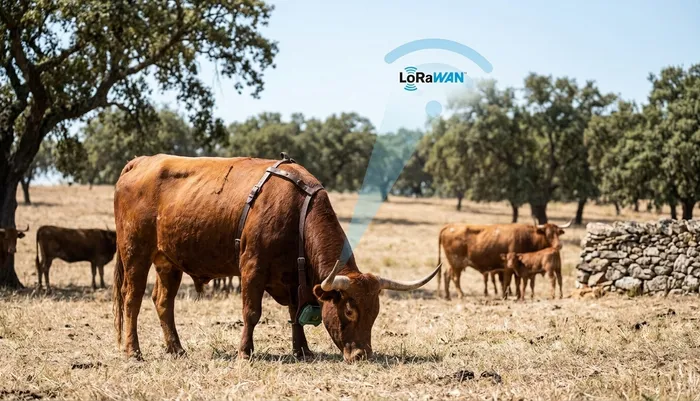 Simulation
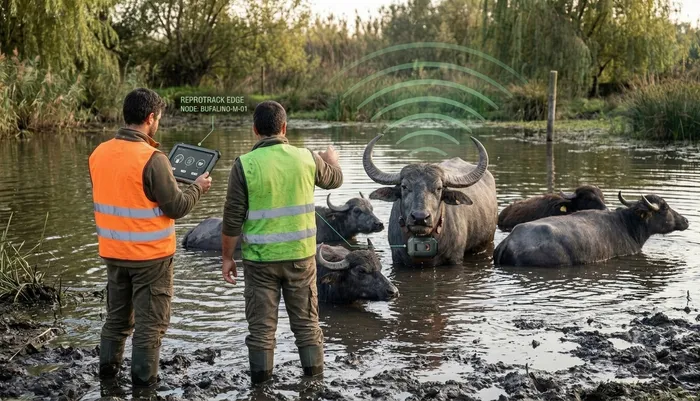 Simulation
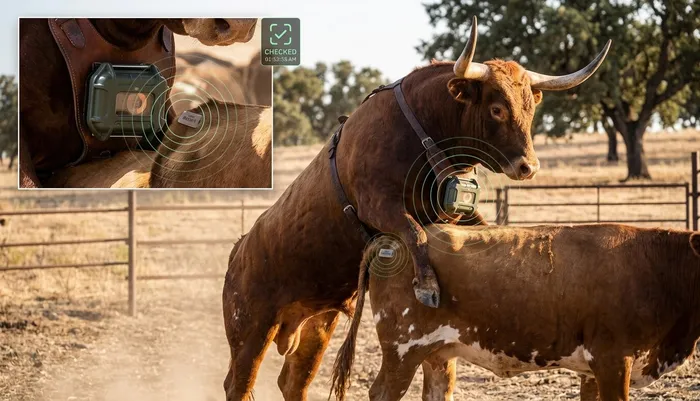 Simulation
Naudy Castellanos
Animal Production Engineer & Computer Engineer
Entry in the 13th edition of the Crédito Agrícola Entrepreneurship and Innovation Award. If you're a producer, researcher or investor who wants to bring ReproTrack to the field, the shortest path is an email.
Team
Darwin Ramírez
Electronics Engineer
Franklin Pérez
Animal Production Engineer & Field Expert